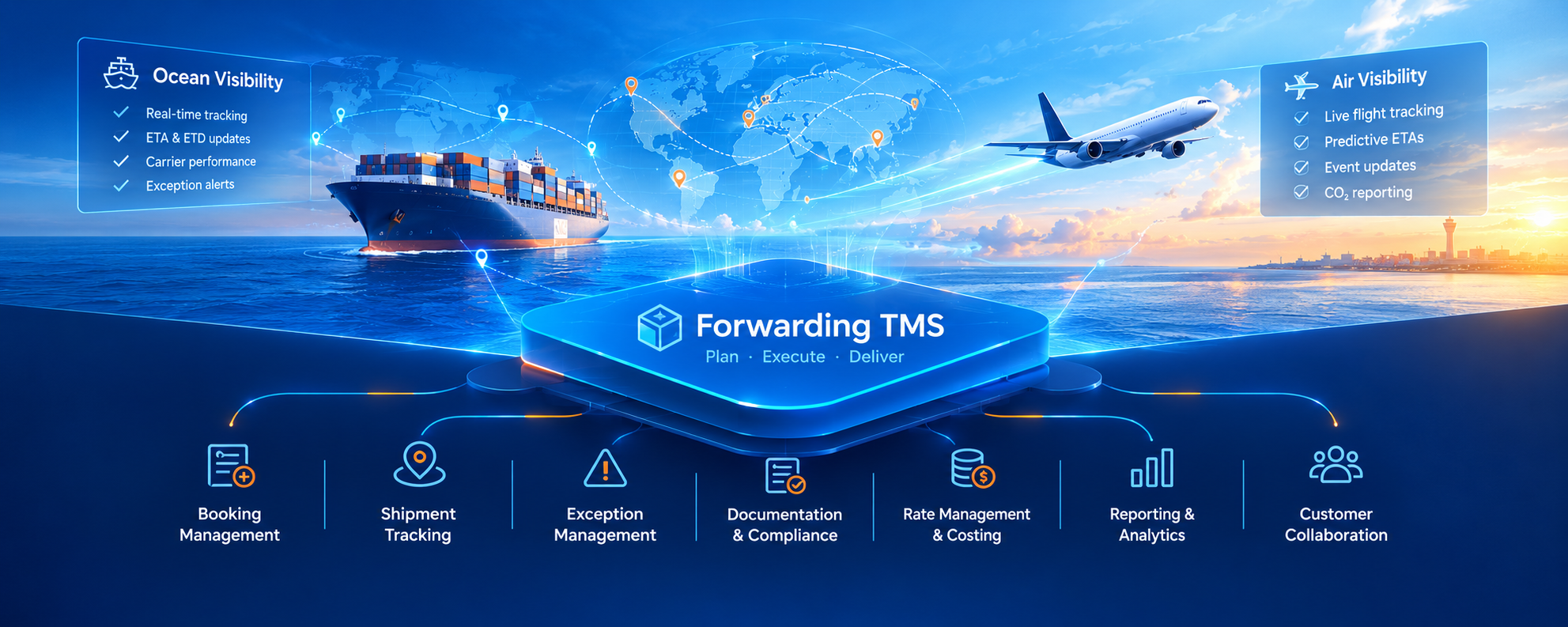
For TMS providers serving international freight, this isn't a nice-to-have anymore - it's essential for winning shipper and freight forwarder deals. Here's a practical guide to adding carrier-neutral visibility and analytics for air and ocean freight to your platform in 2026.
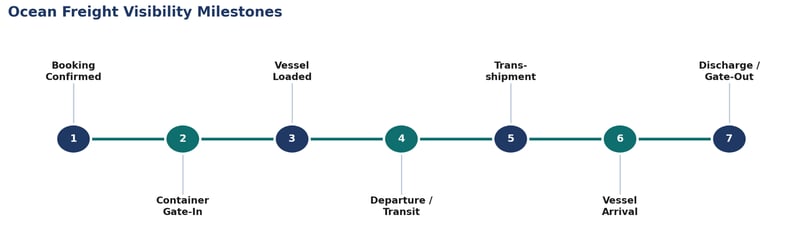
Carrier-neutral tracking spans every milestone — including transshipment legs on feeder vessels
Why “Carrier-Neutral” Is the Non-Negotiable Part
The instinct when building visibility is to integrate directly with the handful of major ocean carriers or airlines customers already book most. That works until a shipment moves on a feeder line, a transshipment carrier, or a smaller regional airline - and coverage collapses exactly where multi-leg international freight needs it most.
Carrier-neutral visibility means your platform ingests data from any ocean carrier or airline, regardless of size - via carrier APIs, EDI, AIS vessel data, port and terminal systems, and airline cargo systems - and normalizes it into one consistent data model. For TMS providers, that's the difference between visibility covering only your top five carriers and visibility covering the transshipment leg on a feeder vessel you have no direct relationship with. Enterprise shippers and forwarders evaluating SaaS logistics solutions increasingly treat carrier-agnostic, mode-spanning coverage as a hard RFP requirement.
Step 1: Decide Build vs. Integrate
Building a carrier-neutral tracking network from scratch means negotiating data-sharing agreements with hundreds of ocean carriers and airlines, ingesting AIS vessel data, and maintaining port/terminal integrations across dozens of countries - a scale few TMS providers can match independently.
The faster path is integrating with an established container-tracking and air-cargo-visibility data provider that has already built that global network, often covering the vast majority of ocean carriers and a large air-cargo footprint through a single API. Your TMS becomes the interface and decision layer; the visibility partner becomes the data layer underneath, freeing engineering to focus on experience rather than carrier-by-carrier data agreements.
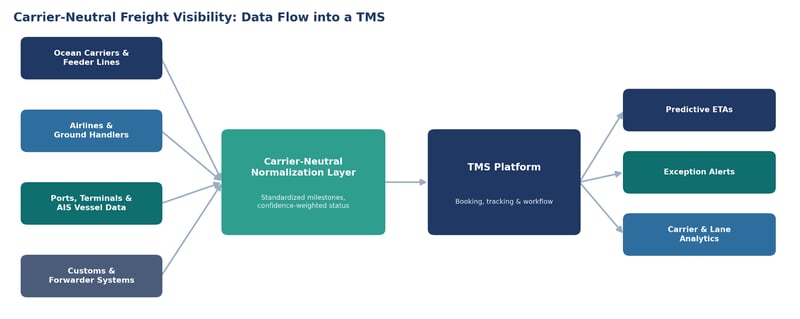
Raw multi-source data is normalized once, then powers tracking, alerts, and analytics inside the TMS
Step 2: Normalize the Data Before You Display It
Raw international freight data arrives messy. Ocean carriers report milestones - gate-in, vessel load, departure, arrival, discharge, gate-out - using different formats and definitions of “departed” or “in transit.” Air cargo adds flight-level tracking, transfer legs, customs holds, and air waybills that move across two or three carriers before reaching their final destination.
Before this data is useful inside a TMS, it needs a normalization layer that maps every carrier's and airline's status codes to one consistent taxonomy, reconciles conflicting position data - AIS pings vs. carrier milestones, flight-tracking vs. airline updates - into a confidence-weighted status, and flags transshipment points explicitly, since that's where shipments are most likely to go dark.
Skipping this step is the single most common reason visibility features get built but don't get trusted. A container tracker that's occasionally wrong about a transshipment is worse than no tracker at all.
.png?width=800&height=243&name=Screenshot%202026-09-09%20195429%20(1).png)
A single air waybill can cross two or three carriers before final delivery — visibility must flow it across every leg.
Step 3: Turn Tracking Into Decision Support
Live location is the entry point, not the destination. What separates a basic tracking tool from genuine logistics analytics is predictive and prescriptive capability layered on top of raw milestone data:
- Predictive ETAs updating continuously from vessel schedules, port dwell data, or flight and customs-clearance patterns - not a static transit time set at booking
- Exception detection flagging a container at risk of missing a transshipment connection, or an air shipment stuck in customs, before it cascades into a missed delivery window
- Carrier and lane scorecards built from on-time performance and transshipment reliability, informing routing decisions
- Demurrage and detention alerts from container availability and terminal free-time data, so customers can act before charges accrue
This is where supply chain visibility stops being a convenience and becomes a genuine driver of routing and inventory decisions.
Step 4: Design the Integration So It's Actually Usable
A common mistake: bolting visibility on as a separate tab users have to remember to check. The more effective pattern embeds it directly into workflows freight teams already live in - a live ETA and transshipment-risk badge on the shipment record, an exception alert routed to the forwarder handling that lane, a carrier reliability score at the point of routing selection.
API-first architecture matters too. As logistics software buyers increasingly expect real-time data exchange between their TMS, customs-documentation systems, and ERP, a visibility layer accessible only through your UI - no webhook or API access - will feel outdated fast, especially to forwarders managing high volumes across many customers.
Step 5: Prove the ROI
Visibility features are easy to build and hard to sell unless you can quantify the impact. Track what customers care about: fewer manual check calls, better ETA accuracy across ocean and air legs, lower demurrage and detention costs, and faster claims resolution from a verified milestone trail.
The Bottom Line
Adding freight visibility to a TMS for international air and ocean freight in 2026 isn't about slapping a map on a dashboard. It's about building - or integrating - a carrier-neutral data foundation spanning carriers, airlines, ports, and terminals; normalizing it so forwarders can trust it across transshipment points; and layering analytics that turn raw milestones into decisions. TMS providers that get this right aren't just adding a feature - they're creating a vital point of difference by becoming the visibility layer international freight operations run on.